
Campus Sustainability News
News on campus sustainability initiatives, emerging programs, rankings, awards, student initiatives, green teams, and more from across the Cornell University campus.
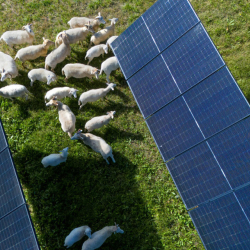
As solar grazing expands across the country, new research helps sheep farmers increase profitability and sheds light on the how the number of sheep in solar array fields interacts with beneficial insects.
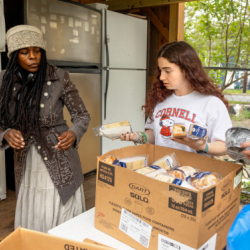
Cornell students are turning campus into a hands‑on sustainability lab—reducing food waste, redistributing surplus meals, and tackling trash with real‑world solutions that make an immediate impact.
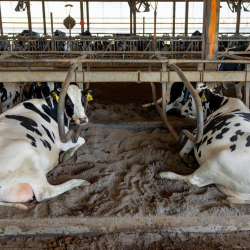
Cornell’s new campus biodigester will turn food waste and manure into clean energy, serving as a model for smaller New York dairy farms.
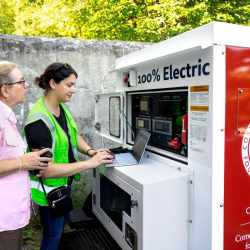
Cornell University is piloting a mobile battery system to replace diesel generators at major events and potentially provide emergency backup power across campus.

Whatever your passion or major, Cornell offers a sustainability course and degree program for you.
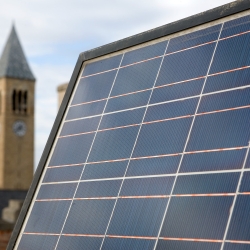
Three more North Campus residential buildings turned on their rooftop solar panels over winter break and now help the campus generate more electricity using renewables.

Get inspired by the depth and breadth of projects advancing sustainability!

A Cornell engineer is advancing the field of ‘multi-sector dynamics’ with a new $1.4 million grant from the U.S. Department of Energy that will focus on techniques for better projecting the outcomes of human interactions with the natural world. As scientists and policy makers increasingly turn toward mathematical modeling to help inform their decision making, the project aims to better predict how human systems – such as the economy, urbanization, technology, and agriculture – co-evolve with Earth systems, such as climate, natural resources and wildlife.

Global warming reduction may someday get a cool new tool: climate engineering. The SilverLining Safe Climate Research Initiative has awarded a $500,000 grant to a Cornell engineering researcher, who will model the effects of introducing reflective aerosols into the stratosphere, which could deflect enough sunbeams to reduce Earth’s temperature and limit climate change impact.

The conference featured three days of problem-solving workshops, such as finding ways to engage students with the United Nations’ Sustainable Development Goals.